
Markers and Plaques Program
Introduction
The Hendersonville Historic Marker and Plaque Program is designed to provide guidelines and criteria to facilitate the approval and placement of historic Markers and Plaques which share concise accounts of Hendersonville’s history at key locations adjacent to or on historic structures and sites within the City’s jurisdiction. The Program will provide funding for approved Markers and Plaques as City resources allow. The Program is a voluntary recognition and educational program. A historic Marker or Plaque awarded under this Program is an honorary form of recognition only. The award of a Marker or Plaque does not designate the associated property as a historic landmark, does not create a historic district, and does not impose any land-use restriction, demolition-delay requirement, certificate-of-appropriateness requirement, or other regulatory control on the recognized property or its owner.
Type and Design
Each marker will be of a roadside marker format and will be the same size and design, unless otherwise determined by the Commission. Applications should consider what type of marker is most appropriate to recognize the historic item.
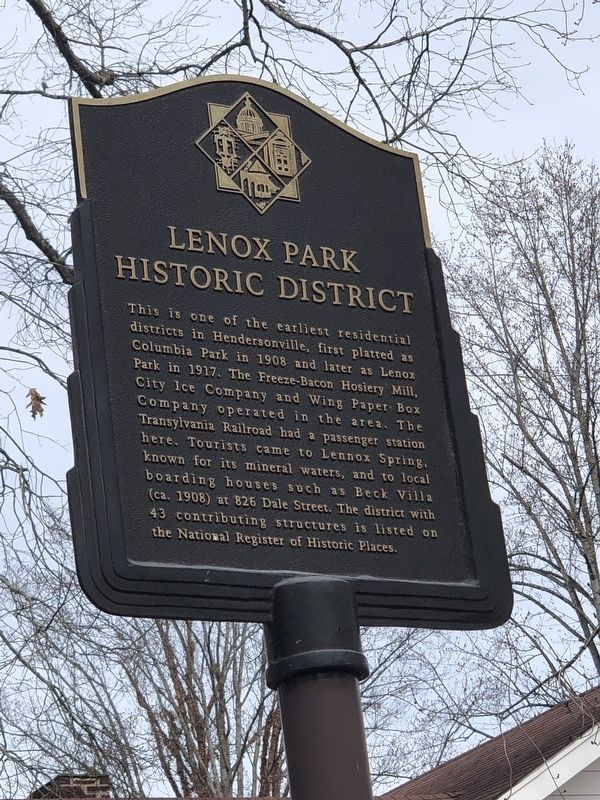
Historic Marker
A freestanding outdoor display mounted on a vertical pole which shares a brief historical summary. Markers are most appropriate when providing an educational narrative for the site or structure. A Marker holds approximately 400 characters and shall be placed in a nearby right-of-way or, where the situation warrants and a right-of-way location is not suitable, on an easement dedicated to the City within the public view.
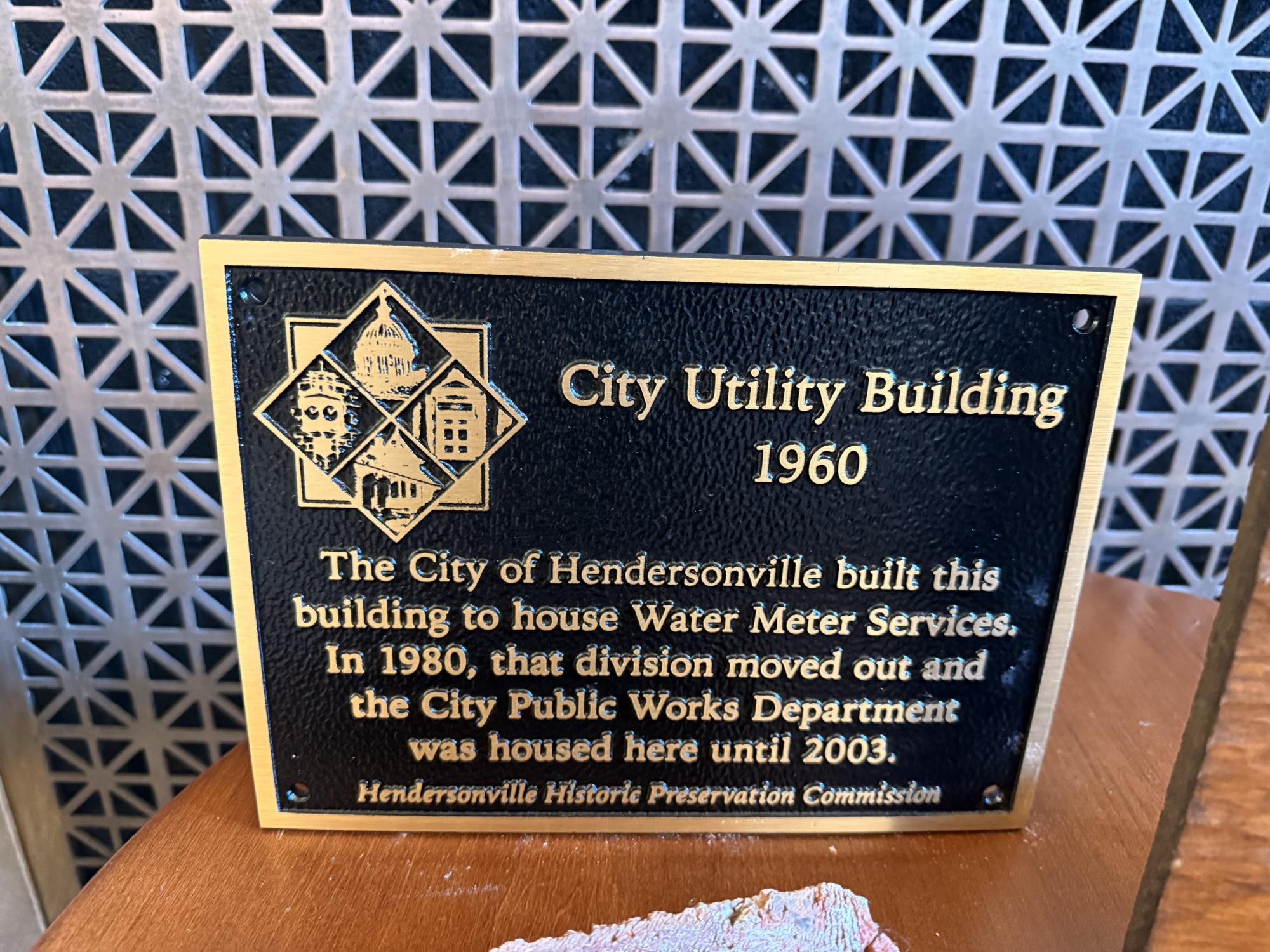
Historic Plaque
A small sign permanently attached to a building or structure which shares brief details about an event, person, or architectural history. Plaques are most appropriate for quickly identifying a historic event or site without an educational narrative. Plaques may contain a title, date, and a sentence or two. Priority is given to plaques which can be placed within the public view, but applications for plaques to be mounted on homes or private buildings are also eligible for funding.
Please note, for the 2026-2027 application cycle, there is no funding for historic markers. However, we still encourage you to apply. If you are selected, you will have the opportunity to receive the marker in future years, or if other funding becomes available.
Applications
Applications for the placement of historic markers and plaques shall be made on forms provided by the City. Applications to the Commission may come from Hendersonville residents, City Staff, or as a request from Hendersonville City Council. There are separate applications for historic markers and historic plaques, and applicants should consider which form of recognition is most appropriate for the site. See the application documents for details on required materials. Applications that may be eligible for recognition via the North Carolina Highway Historical Marker Program may be encouraged to apply for the state program.
2026-2027 Deadlines:
December 4th - Applications released.
January 15th – Application deadline.
February 10th – Qualifying applications are considered by the Historic Designation Committee at their monthly meeting. Committee will make recommendations which shall be presented to the Commission.
February 17th – Historic Preservation Commission to consider the Committee’s recommended applications.
April - Historic Preservation Commission unveils 2026-2027 plaques and markers.
Other Helpful Information
Upon receipt of an application, Staff will determine whether the request meets the Qualifying Criteria set forth in Section A. If the application is deemed complete, the Historic Designation Committee will review and score the applications using the criteria set in Section B. Applications for markers are required to attend the Historic Designation Committee meeting and make a brief presentation on the application and achieved criteria. Applications for the plaques are encouraged to attend to respond to questions and provide a brief history to the Committee. The top scoring applications will be recommended to the Historic Preservation Commission for final approval and potential funding.
Qualifying Criteria
If the application fails to meet all the following criteria it will be considered ineligible for a historic marker or plaque.
- Structure, neighborhood, site, event, or organization must be over 50 years old.
- Topic not currently marked in Hendersonville by any other marker program, either public or private.
- A historic marker is found to be the appropriate form of recognition for the site.
- Proposed marker location must be in the public view.
Priority Evaluation System
If the application meets the Qualifying Criteria, the application will be brought to an annual Historic Designation Committee meeting. The Committee will evaluate each application using the Evaluation Criteria below. The top scoring applications will be presented to the Historic Preservation Commission for final approval. Applications which fail to meet the minimum point requirements of any priority will be considered ineligible for a historic marker or plaque. After reviewing each application, the Committee will have the opportunity to ask questions, and the public will have an opportunity to comment in support of, or opposition to, the application.
Applicants are encouraged to attend the Historic Designation Committee meeting to provide a brief history of the proposed plaque and respond to any questions.
- Priority One: Each criterion met is given up to 5 points (20 maximum, 10 minimum)
- Plaque location is in the public view.
- Lesser-known historic structure, neighborhood, site, event, or organization
- Topic of historical or cultural significance that has been demolished.
- Historic or cultural event at a specific site.
- Priority Two: Each criterion met is given up to 3 points (15 maximum, 7 minimum)
- Plaque topic is broadly significant to the history of Hendersonville.
- Endangered or threatened structure, neighborhood, or site.
- Existing structure or neighborhood with historical or cultural significance.
- Historic designed landscape, such as a cemetery, farm, garden, or park.
- Organization with historical or cultural significance.
- Priority Three: Each criterion met is given up to 1 point (5 maximum, 2 minimum)
- Topic fills a gap in the narratives covered by existing historic markers.
- Contributes to an even geographic distribution of markers and plaques.
- Helps create a sense of place or identify an area.
- Recognizes a preserved or restored structure, neighborhood, or site.
- Application is from the rollover list.
At the Historic Designation Committee meeting the applicant shall make a brief presentation to the Committee outlining the proposed Marker and achieved criteria.
- Priority One: Each criterion met is given up to 5 points (20 maximum, 10 minimum)
- Marker topic has the potential to educate the public.
- Lesser-known historic structure, neighborhood, site, event, or organization.
- Topic of historical or cultural significance that has been demolished.
- Historic or cultural event at a specific site.
- Priority Two: Each criterion met is given up to 3 points (15 maximum, 7 minimum)
- Marker topic is broadly significant to the history of Hendersonville.
- Endangered or threatened structure, neighborhood, or site.
- Existing structure or neighborhood with historical or cultural significance.
- Historic designed landscape, such as a cemetery, farm, garden, or park.
- Organization with historical or cultural significance.
- Priority Three: Each criterion met is given up to 1 point (5 maximum, 2 minimum)
- Topic fills a gap in the narratives covered by existing historic markers.
- Contributes to an even geographic distribution of markers.
- Helps create a sense of place or identify an area.
- Recognizes a preserved or restored structure, neighborhood, or site.
- Application is from the rollover list.
Ownership, installation, and maintenance responsibilities will be finalized in writing prior to approval and funding of any marker or plaque, as set out below. As set out hereinabove, markers and plaques awarded under this Program remain a form of honorary recognition and do not create any land-use restriction, landmark designation, or other regulatory control over the recognized property.
No marker or plaque may be placed on private property, including a Plaque mounted on a building façade, without the written consent of the property owner.
Markers
Each marker is owned and maintained by the City, regardless of funding source. A Marker shall be placed in a nearby right-of-way, in a location to be determined by the City. Alternatively, where a right-of-way location is not available or suitable and the situation warrants, the City may, in its sole discretion, consider acquiring an easement by dedication from the property owner to place and maintain the Marker. Markers shall be installed by the City, regardless of where the Marker is place and whether the Marker is self-funded.
Where a Marker is proposed within a street or highway right-of-way that is under the jurisdiction of the North Carolina Department of Transportation (NCDOT), the City shall obtain the authorization required for use of that right-of-way before installation. If the City in unable to obtain said authorization, the City may consider, but shall not have the obligation, to consider acquiring an easement for the placement of the Marker.
Plaques
A Plaque attached to a building or other structure remains the property of the City, unless the Plaque is self-funded. The property owner installs the Plaque on the building or structure. The City may provide the property owner with basic information and resources on how to install the Plaque appropriately for the applicable building material, which information shall not constitute a warranty or create any liability for defective installation on the part of the property owner.
Historic markers and plaques will be funded by the City as resources allow each year. For the avoidance of doubt, this Policy does not create an obligation for the City to fund any minimum number of markers and/or plaques. The Historic Designation Committee may consider allotted funding along with the number and type of applications received.
Private property owners, nonprofit organizations, or governmental departments/agencies may apply for self-funded markers for eligible sites. Historic Preservation Commission staff will assist with ordering all self‐funded markers, but applicants are responsible for the payment of all costs, including purchase, shipping, and installation costs. All markers and plaques will be in the same format outlined above.
The City owns and maintains each Marker, regardless of funding. The City owns, but has no specific maintenance obligation for each City-funded Plaque. The City does not retain an ownership interest in self-funded plaques. If an approved marker or plaque is damaged and must be replaced, the Historic Preservation Commission may approve the purchase of a replacement as funding allows. Replacement markers and plaques shall match the established format. Reinstallation of a replacement will be managed by Historic Preservation Commission members and Staff and, for a Plaque, installed by the property owner in the same manner as the original.
A marker or plaque may need to be relocated or removed, for example, to preserve or repair the marker, to accommodate construction, renovation, or a transportation project, to address an unsafe condition, or at the documented request of the property owner on whose building a Plaque is mounted. A Marker located in an NCDOT right-of-way may also be subject to relocation or removal under the terms of the applicable encroachment agreement and governing right-of-way rules.
Because markers and plaques awarded under this Program are intended to be permanent commemorative objects, some may qualify as an “object of remembrance” subject to State-law limitations on the permanent removal or relocation of such objects on public property. Before permanently removing or relocating any City-owned marker or plaque that may be subject to those limitations, Staff shall confirm that the proposed action is permitted under, and is carried out consistent with, applicable State law, including any requirement to return a temporarily relocated object to its original location within the required period and to relocate a permanently removed object to a site of similar prominence within the City’s jurisdiction. This Program does not authorize any removal or relocation that applicable law prohibits. See. N.C.G.S. 100-2.1.
At the written request of the applicant, applications that are not selected by the Historic Preservation Commission, meet the minimum scoring criteria, and choose not to pursue a self-funded Marker or Plaque, will be placed on a rollover list to be considered the following year. Applicants for Markers must be prepared to make a presentation to the Designation Committee each year to ensure full consideration. Inclusion on the list is not a guarantee that the application will be selected in the future.
The following terms have the meanings set forth below when used in this Policy:
Commission. The Hendersonville Historic Preservation Commission, which gives final approval to Markers and Plaques under this Policy.
Committee. The Historic Designation Committee, a sub-committee of the Commission, which reviews and scores applications and recommends them to the Commission. If the City or the Commission designate another public body with authority related to administering this Policy, then Committee shall refer to said public body.
Marker. A freestanding outdoor display mounted on a vertical pole that shares a brief historical summary and is intended to provide an educational narrative for a site or structure. A Marker is placed in a right-of-way or otherwise within the public view. Unless the context indicates otherwise, references in this Policy to a “marker” or “single post sign” mean a Marker.
Plaque. A small sign permanently attached to a building or other structure that shares brief details, such as a title, date, and a sentence or two, about an event, person, or architectural history. A Plaque typically identifies a historic event or site without providing an extended educational narrative.
Self-Funded Marker. A Marker or Plaque for an eligible site for which a private property owner, nonprofit organization, or governmental department or agency pays all purchase, shipping, and installation costs, in the same format as City-funded markers and plaques.
Titles and text inscriptions should be drafted as a part of the application. This language will be reviewed by the Historic Designation Committee who will provide feedback and edits before the final recommendations are approved by the Historic Preservation Commission. Commission and Committee staff do not editorialize or speculate, the text will only include widely acknowledged historical facts. Additionally, space limitations due to the size and configuration of the markers require concise statements. Review the current application for character limits.